Sargie is a French Wire-Haired Korthals Pointing Griffon — a working dog bred for endurance and field performance. When he presented to the orthopaedic team at Langford Small Animal Hospital, he had sustained one of the worst stifle injuries a dog can suffer: rupture of both the cranial and caudal cruciate ligaments.
Not one cruciate. Both.
The case was referred to Kevin Parsons BVSc PhD DipECVS MRCVS, RCVS Recognised Specialist in Small Animal Surgery (Orthopaedics), at Langford Veterinary Services — the University of Bristol's small animal referral hospital, one of the leading specialist centres in the UK. Sargie underwent TPLO surgery (Tibial Plateau Leveling Osteotomy), the gold standard surgical procedure for cruciate disease in dogs.
Sargie's owner — my father — was told what came next would determine whether this dog ever worked properly again.
Six Days Post-Surgery
Six days after TPLO, Sargie was on a FitFurLife treadmill.
That might sound aggressive. For many owners, the instinct after major surgery is rest — keep the dog still, let things heal. But early controlled movement following cruciate surgery is increasingly recognised as critical to outcome. Prolonged rest leads to muscle atrophy, reduced proprioception, and compensatory loading on the opposite limb. The longer a dog avoids loading the operated leg, the harder it becomes to correct.
The treadmill provides something a lead walk cannot: total control over speed, surface, and loading. At very low speed — as slow as 0.4 km/h — the dog cannot compensate by hopping, scuffing or shifting weight. The belt moves at a pace that requires correct limb placement. There is no option to cheat.
The Programme
My father followed the rehabilitation programme without exception. Three sessions daily, every day, for twelve weeks. The level of compliance was exceptional — and it showed in the outcome.
The protocol, developed over 21 years alongside veterinary physiotherapy professionals including Karl Jones MSc (Vet Physiotherapy), Chartered Physiotherapist:
The principle: The affected limb must be bearing weight correctly from session one. Speed increases only when correct placement is consistent. Duration builds gradually — early sessions were five to eight minutes only.
Incline for hind leg rehabilitation. Incline shifts the dog's weight rearward, increasing load through the hindquarters and accelerating muscle rebuild in the operated leg. As Sargie strengthened, incline became central to his programme.
Measuring Progress: The Numbers
Before starting rehabilitation, stifle (knee) circumference measurements were taken on both hind limbs. These measurements are a direct indicator of muscle mass — and they tell the story of the rehabilitation more clearly than any description can.
One week post-operation:
- Left hind (operated limb): 43 cm
- Right hind: 36.5 cm
The difference of 6.5 cm reflects the combination of post-surgical swelling on the operated side and existing muscle imbalance.
Twelve weeks post-operation:
- Left hind: 41 cm
- Right hind: 41 cm
Equal. Bilateral symmetry — the goal of every rehabilitation programme — achieved at twelve weeks.
Progress at Seven Weeks
At the seven-week orthopaedic recheck at Langford, Sargie was assessed as 1/10 lame on the operated limb — clinically near-sound. Radiographs confirmed good healing at the TPLO site. He was already on 25 minutes of treadmill walking daily, alongside controlled lead exercise.
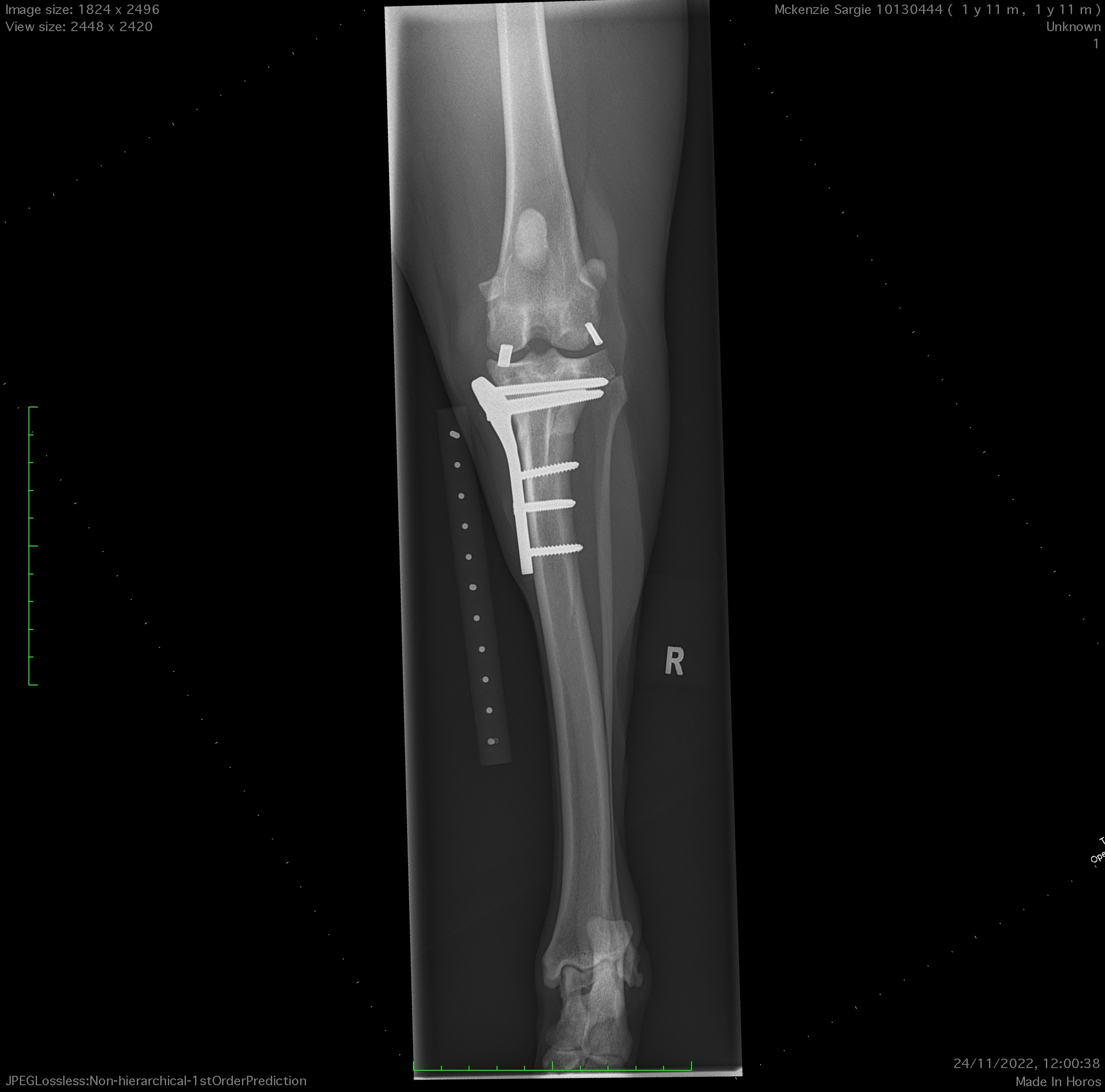
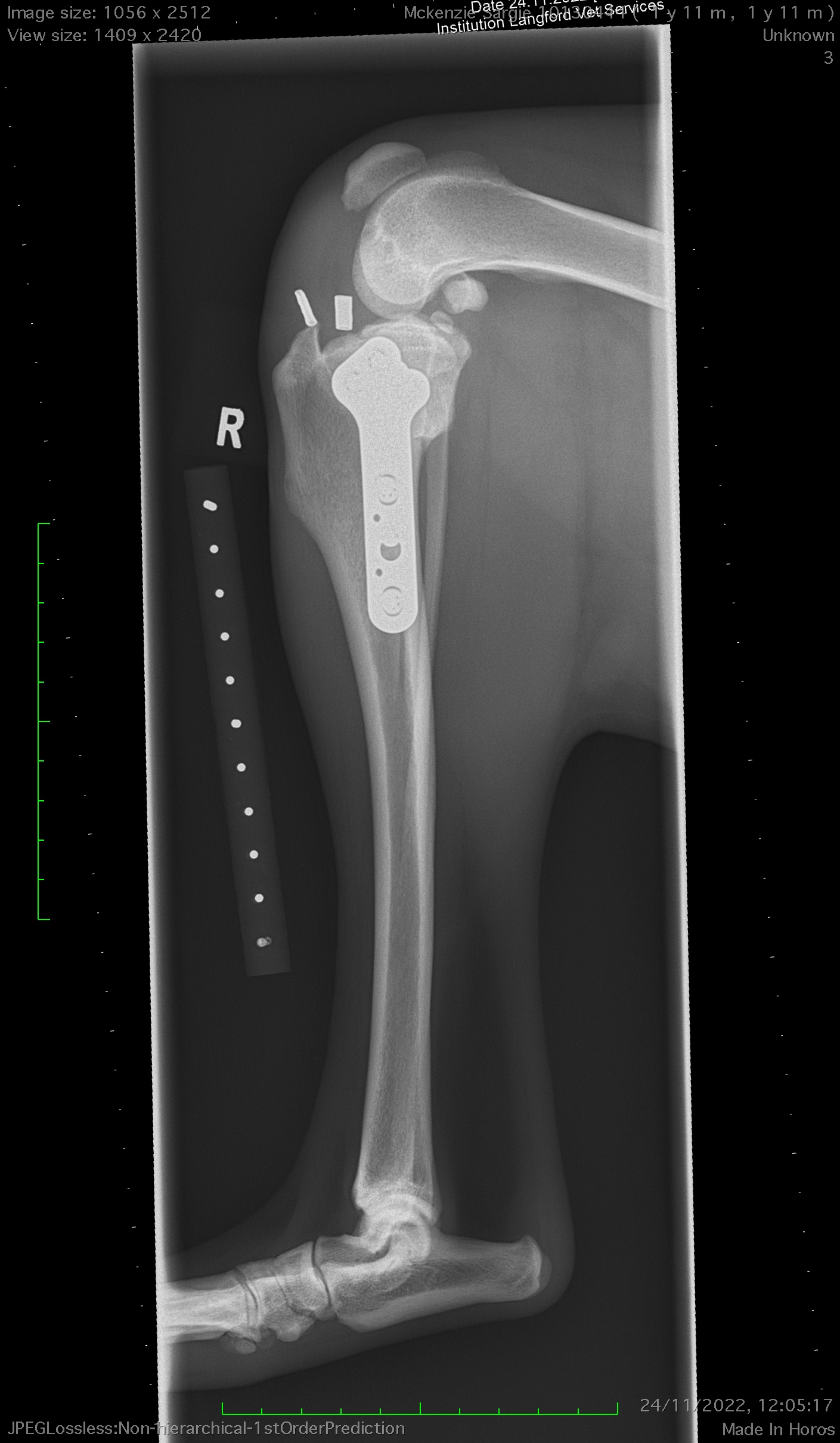
The Langford report noted the treadmill as an established part of the rehabilitation protocol. The team was satisfied with his progress.
The Result
That autumn — the same year as his surgery — Sargie was back in the field.
For a working dog, that is the only measure that matters. Not sound movement on a flat surface in a controlled environment, but the full demands of fieldwork: turns, sprints, uneven ground, sustained effort over distance. He met every one of them.
What Made the Difference
Three things:
Specialist surgery. TPLO at a referral centre, performed by an RCVS specialist, gave Sargie the best possible foundation for recovery.
Early, controlled movement. Starting treadmill rehabilitation at six days prevented the muscle atrophy and compensatory patterns that extend recovery — or make full recovery impossible.
Owner commitment. Three sessions a day, twelve weeks, no gaps. Most rehabilitation programmes involve compromise. This one didn't.
The principles are the same regardless of the severity of the injury:
- Start early under veterinary guidance — controlled movement protects, not damages
- Control the speed — low pace removes the option to compensate
- Use incline for hind leg cases — it directs load exactly where it needs to go
- Build gradually — always let correct movement lead the progression
- Be consistent — rehabilitation compounds daily, and so does inactivity
A Note on Professional Guidance
This case was managed under veterinary and physiotherapy oversight from the outset. Sargie's rehabilitation protocol was shaped by Karl Jones MSc (Vet Physiotherapy) BSc(Hons) ACPACT CAT A, CSP HPC, who worked with FitFurLife for many years. Every post-surgical case is different. Always work with your vet or veterinary physiotherapist to design a programme appropriate to your dog's specific injury, surgical outcome, and progress.
Langford Small Animal Hospital is a specialist referral centre operated by Langford Veterinary Services, University of Bristol. FitFurLife has been supporting post-surgical rehabilitation with professional treadmill equipment for 21 years. If you are managing a post-surgical case and want to discuss whether a treadmill programme may be appropriate, contact us.